

ESG challenges cannot be addressed through theory alone
Integrating ESG principles requires more than reading a guide or attending a presentation.
Every small and medium-sized enterprise has:
- A different level of ESG readiness
- Different operational priorities
- Different available resources
- Different skills and knowledge gaps
- Different environmental and social impacts
A coastal tourism business may be concerned about water consumption, waste generation and seasonal employment.
A maritime services company may require guidance on emissions, occupational safety or environmental risk management.
An aquaculture business may focus on biodiversity, traceability, water quality and relationships with local communities.
For this reason, the ESG transition requires practical guidance, knowledge exchange and access to professionals who can transform general principles into realistic actions.
What is a Community of Practice?
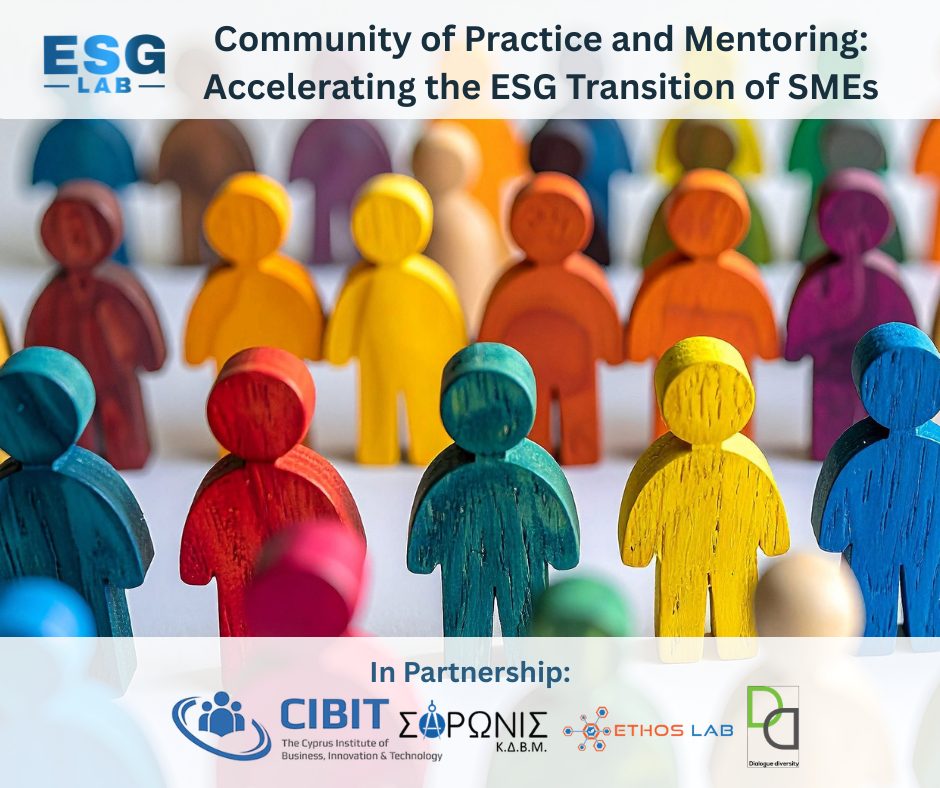
A Community of Practice is a group of people and organisations that share a common field of interest and develop knowledge through regular interaction and collaboration.
Within the ESG context, a Community of Practice may bring together:
- Small and medium-sized enterprises
- Business professionals
- Consultants and ESG experts
- Trainers and mentors
- Educational and research organisations
- Institutional stakeholders
- Industry representatives
- Community organisations
The value of the community lies in practical knowledge exchange.
Members can discuss real challenges, present solutions, share tools and learn from both successful and less successful experiences.
From general knowledge to customised implementation
A webinar can introduce the main principles of ESG reporting.
A digital tool can help a company assess its level of readiness.
However, guidance from an experienced mentor can help management interpret the results and determine which actions are most relevant for the business.
Mentoring can support an SME in:
- Identifying its most material ESG topics
- Selecting appropriate and realistic indicators
- Organising data-collection procedures
- Establishing measurable objectives
- Preparing an ESG action plan
- Improving an existing ESG Report
- Assigning internal responsibilities
- Monitoring progress over time
The mentor does not replace the management of the business.
Instead, the mentor acts as a facilitator, helping the company make informed decisions and avoid unrealistic or fragmented actions.
The importance of exchanging experiences
SMEs often face similar difficulties, including:
- Limited time and financial resources
- Lack of specialised personnel
- Difficulty collecting reliable data
- Uncertainty regarding sustainability standards
- Limited experience in ESG reporting
- Difficulty identifying appropriate indicators
Within a Community of Practice, a business can discover that other organisations have faced similar challenges.
It can learn from examples of:
- Internal procedures
- Environmental policies
- Employee initiatives
- ESG indicators
- Reporting structures
- Data-collection templates
- Action plans
These examples can then be adapted to the specific needs and operational reality of the business.
Knowledge exchange reduces isolation, prevents the repetition of common mistakes and increases the confidence of businesses in their ability to take action.
The European dimension of ESG LAB
ESG LAB connects organisations, businesses and stakeholders from Greece, Cyprus and Portugal.
This transnational cooperation supports the exchange of different business, regional and sectoral experiences within the Blue Economy.
Although businesses operate in different markets, many of their challenges are shared, including:
- Protection of natural resources
- Adaptation to climate change
- Development of green and digital skills
- Responsible governance
- Increasing transparency
- Strengthening organisational resilience
Collaborative learning can lead to solutions that are both locally applicable and aligned with broader European sustainability priorities.
A support ecosystem for SMEs
The ESG LAB Community of Practice complements the project’s other tools and activities.
The ESG LAB ecosystem includes:
- An Online Library providing access to studies, guides and good practices
- Webinars and podcasts supporting knowledge and skills development
- Diagnostic and self-assessment tools for evaluating ESG readiness
- A Reporting Tool for presenting ESG performance in a structured way
- Mentoring activities for adapting tools to the needs of each business
- Opportunities for networking and exchange among stakeholders
Together, these resources provide a more comprehensive support system for SMEs beginning or strengthening their ESG journey.
Sustainability as a collaborative process
The ESG transition is not a destination that a business reaches on its own.
It is a continuous process involving:
- Learning
- Implementation
- Measurement
- Evaluation
- Cooperation
- Continuous improvement
When businesses have access to appropriate knowledge, practical tools, experienced mentors and an active network of partners, they can move forward with greater clarity and confidence.
Through collaboration, sustainability stops being an abstract obligation and becomes a practical opportunity for resilience, innovation and responsible growth.