

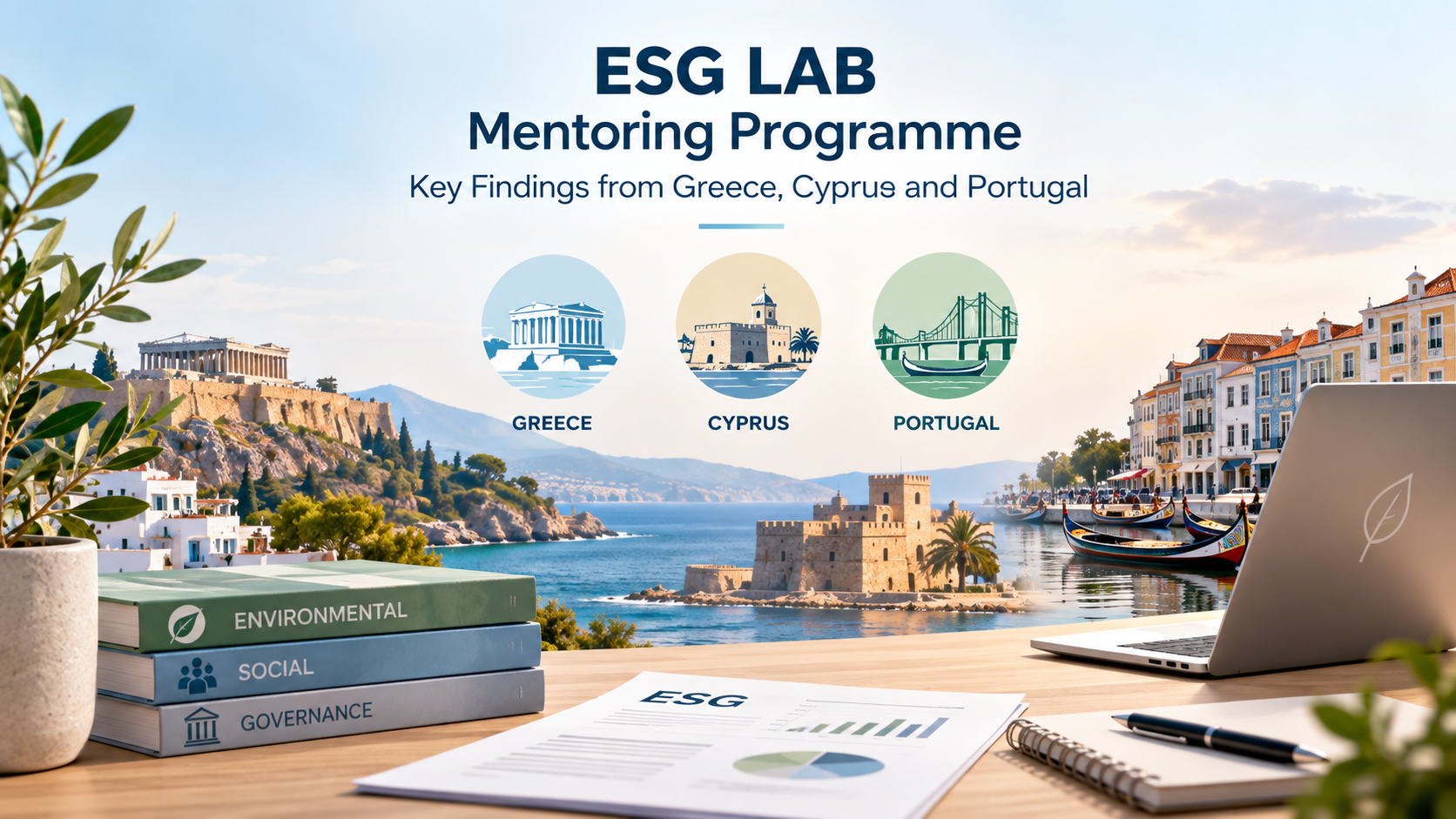
As part of Activity 4 of the ESG LAB project, the national mentoring programme supported SMEs in Greece, Cyprus and Portugal in better understanding their ESG position, identifying practical priorities and taking the first steps towards more structured and evidence-based ESG management.
Although the participating companies represented different sectors, sizes and levels of ESG maturity, the national mentoring reports reveal several common challenges and learning needs, particularly around data collection, ESG indicators, internal responsibilities and reporting.
Greece
In Greece, five SMEs and organisations participated in the mentoring process. The main finding was that, although many already had relevant sustainable practices or policies in place, these were generally not yet translated into a structured ESG system.
The mentoring helped participants identify sector-specific priorities, establish initial ESG baselines and develop practical action plans and first reporting frameworks. Particular emphasis was placed on reliable data collection, a manageable set of KPIs and clearly assigned responsibilities. ESG LAB
The Greek experience highlighted the value of keeping ESG support proportionate, practical and adapted to the realities of smaller organisations, rather than introducing overly complex reporting requirements from the beginning.
Cyprus
The Cyprus mentoring programme also involved five SMEs from a variety of sectors. A key conclusion was that many companies were already carrying out activities relevant to ESG, but often lacked a consolidated system for collecting evidence, assigning data ownership and monitoring indicators over time.
Through the mentoring process, each participating SME developed a clearer ESG baseline, priority areas, an action plan and a first ESG reporting structure. The experience showed that SMEs can make significant progress when ESG is approached as a practical management and data exercise, supported by realistic targets and a small number of relevant indicators.
Portugal
In Portugal, five SMEs from the Aveiro region took part in face-to-face diagnostic mentoring. The process identified different ESG starting points across the companies, while highlighting a particularly strong need for better environmental measurement, transparent reporting, governance oversight and evidence-based monitoring.
The mentoring created ESG baselines, training-needs profiles and detailed reporting action plans. One important lesson was that ESG scores alone do not necessarily indicate reporting readiness: companies also need clear reporting boundaries, reliable evidence and a limited number of meaningful indicators before moving towards a complete ESG report.
Common Lessons Across the Three Countries
Across Greece, Cyprus and Portugal, the mentoring activities demonstrated that SMEs benefit most from an approach that makes ESG concrete, manageable and connected to day-to-day business operations.
Common priorities included improving ESG data collection, defining sector-relevant KPIs, assigning responsibilities, strengthening evidence management and creating realistic reporting processes. At the same time, the results confirmed the importance of adapting ESG support to the size, sector and maturity of each company, rather than applying a one-size-fits-all approach.
The national mentoring reports provide further details on the implementation, findings and recommendations from each participating country and are available below.