

Blue Economy in the Mediterranean: How Portugal, Greece and Cyprus Are Shaping a Sustainable Maritime Future
The Blue Economy has become one of the most important drivers of sustainable development across Europe. It encompasses all economic activities linked to oceans, seas and coastal areas, including fisheries, aquaculture, maritime transport, coastal tourism, offshore renewable energy, marine biotechnology and ocean innovation. The concept promotes economic growth while ensuring the protection and sustainable use of marine resources.
For Mediterranean countries such as Portugal, Greece and Cyprus, the Blue Economy is not simply an environmental ambition; it is a strategic pillar for economic development, employment and innovation.
Portugal: Investing in Innovation and Ocean Knowledge
Portugal has one of the largest maritime areas in Europe and has placed the ocean at the centre of its long-term development strategy. According to the EU Blue Economy Observatory, the Portuguese Blue Economy directly employed approximately 295,600 people and generated around €7.8 billion in Gross Value Added (GVA) in 2022. The sector represents approximately 3.7% of the national GVA and 6% of total employment.
The country is increasingly focusing on emerging sectors such as offshore renewable energy, sustainable aquaculture, marine biotechnology and digital technologies applied to maritime activities. Initiatives such as the Blue Economy Cluster and the Portugal Blue Digital Innovation Hub support entrepreneurship, research, artificial intelligence applications and digital transformation in maritime industries.
Portugal’s National Ocean Strategy 2021–2030 further reinforces the country’s commitment to combining ocean conservation with economic growth, positioning Portugal as a leading European player in sustainable maritime innovation.
Greece: Balancing Tourism, Fisheries and Marine Protection
Greece possesses one of the longest coastlines in Europe and a strong maritime tradition. The Greek Blue Economy is largely driven by coastal tourism, which accounted for approximately 83% of Blue Economy employment in 2022, according to the EU Blue Economy Observatory.
At the same time, fisheries and aquaculture remain important economic activities, particularly in island and coastal communities. Greece is also exploring opportunities in offshore renewable energy and maritime spatial planning, seeking to balance economic growth with environmental protection.
Recent developments include the submission of Greece’s Maritime Spatial Plans to the European Union in 2025. These plans aim to organise activities such as tourism, fisheries, aquaculture, maritime transport and renewable energy while ensuring the protection of marine ecosystems.
However, Greece also faces challenges associated with overtourism and coastal pressure. Sustainable management of tourism destinations and marine resources has therefore become a central priority for ensuring the long-term resilience of the country’s Blue Economy.
Cyprus: A Maritime Economy Built Around Tourism and Shipping
As an island nation located at the crossroads of Europe, Asia and Africa, Cyprus has naturally developed a strong maritime identity. Coastal tourism remains the dominant Blue Economy sector, accounting for approximately 87% of blue jobs and 80% of the sector’s Gross Value Added in 2022.
Shipping also plays a crucial role in the Cypriot economy. Recent estimates indicate that the shipping sector contributes around 7% of Cyprus’s GDP, reinforcing the country’s position as an important maritime services centre in the Eastern Mediterranean.
Cyprus is actively investing in maritime innovation, sustainable tourism, marine aquaculture and maritime spatial planning. Through its Smart Specialisation Strategy, the country has identified shipping, tourism, energy and environmental innovation as key sectors for research and economic growth.
Furthermore, new maritime spatial planning frameworks are designed to facilitate investment in offshore renewable energy, marine aquaculture, cruise tourism and marine environmental protection.
A Shared Mediterranean Vision
Despite their different economic structures, Portugal, Greece and Cyprus share common priorities within the Blue Economy:
- Promoting sustainable coastal and maritime tourism;
- Supporting innovation and digital transformation;
- Developing sustainable aquaculture and fisheries;
- Expanding offshore renewable energy opportunities;
- Protecting marine biodiversity and coastal ecosystems;
- Strengthening cooperation between research institutions, businesses and public authorities.
The Blue Economy is increasingly recognised as a pathway towards a greener, more resilient and competitive Europe. For Portugal, Greece and Cyprus, the sea is not only part of their history and identity—it is also a fundamental resource for building a sustainable future.
As climate change, biodiversity loss and resource pressures continue to affect coastal regions worldwide, these Mediterranean countries demonstrate that economic growth and environmental responsibility can go hand in hand when supported by innovation, cooperation and long-term strategic planning.
Sources used: EU Blue Economy Observatory country profiles for Portugal, Greece and Cyprus; Portugal Blue Economy Cluster; Portugal Blue Digital Innovation Hub; Cyprus Investment Hub; National Ocean Strategy Portugal 2021–2030; European Commission Blue Economy reports.
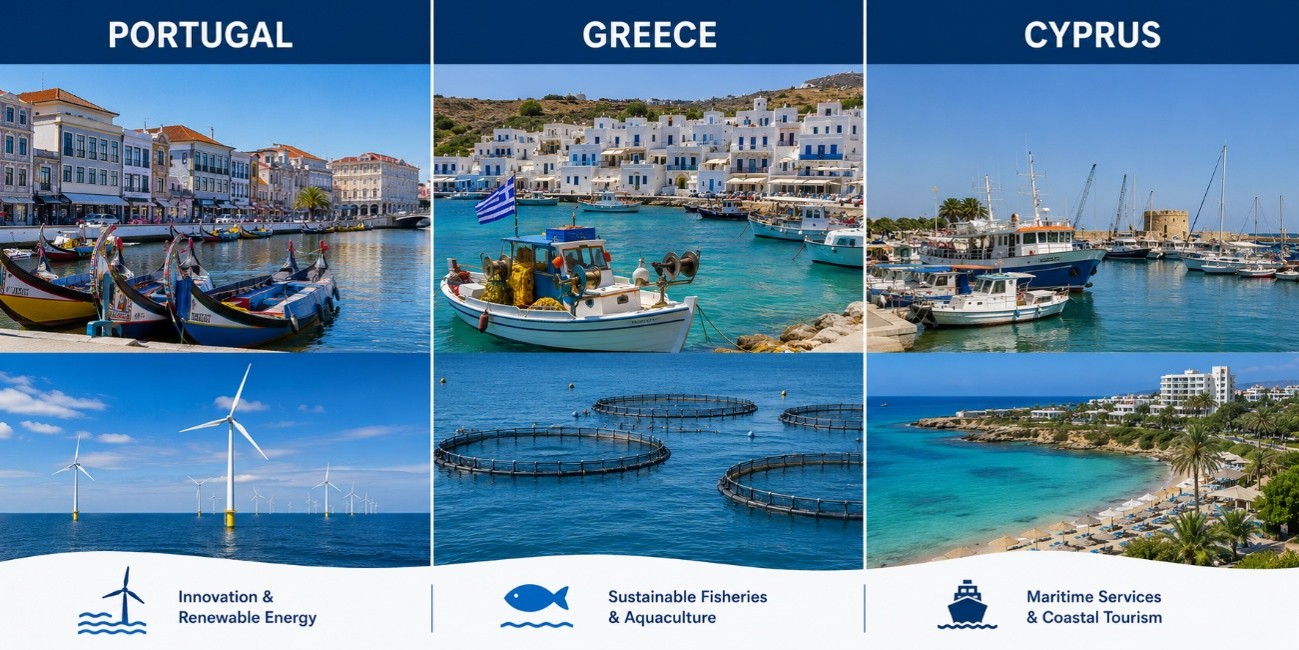
llustrative image representing Blue Economy activities in Portugal, Greece and Cyprus, including maritime innovation, aquaculture, renewable energy, shipping and coastal tourism.
Image source: AI-generated illustration created for the ESG LAB project.